
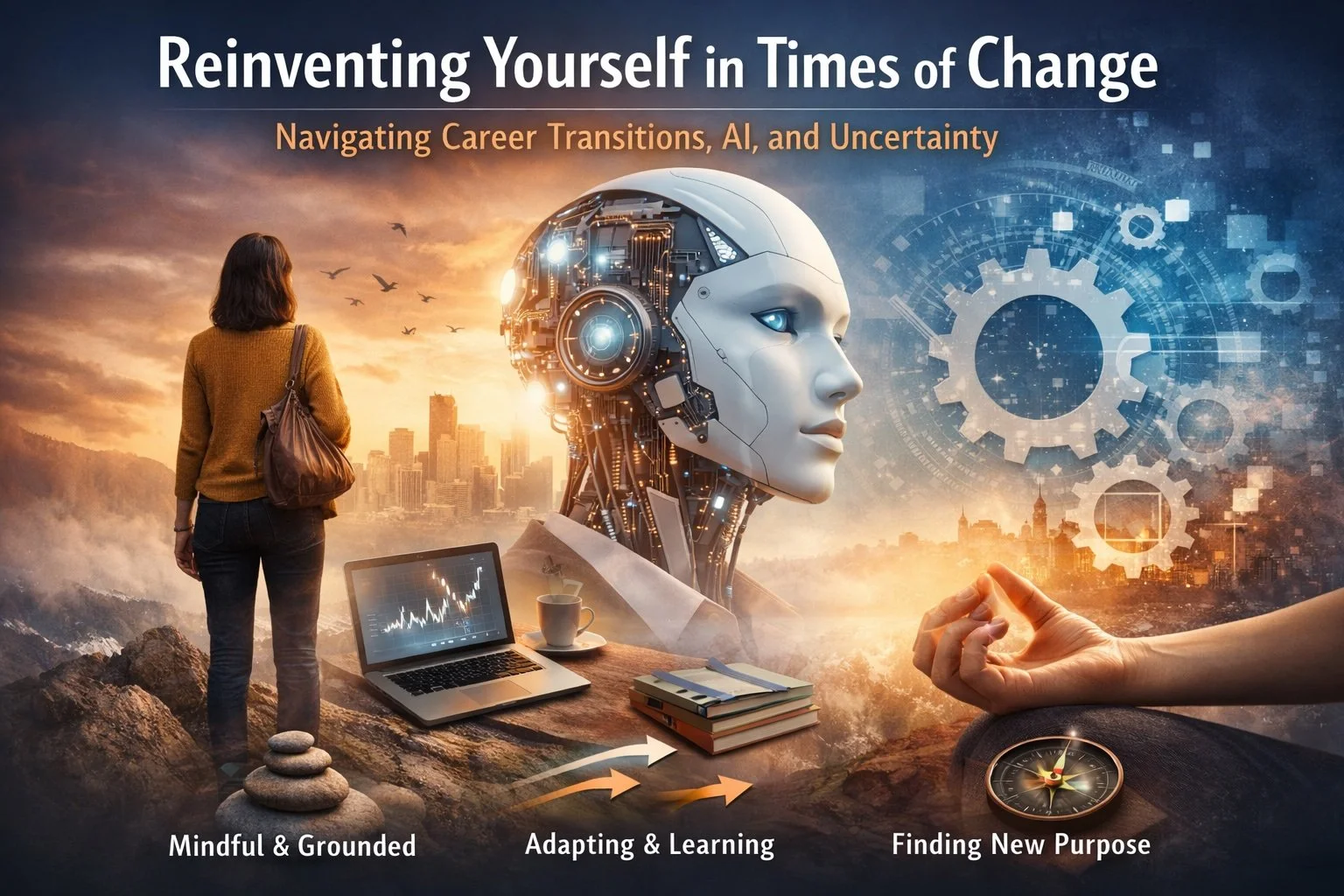
Reinventing Yourself in Times of Change: Navigating Career Transitions, AI, and Uncertainty
When Change Becomes Collective
There are moments in history when change is no longer personal—it becomes collective. The COVID-19 pandemic marked one of those turning points, disrupting not only public health but also how we work, relate, and define ourselves.
Now, as artificial intelligence rapidly transforms industries and careers, we find ourselves in another wave of transition. These shifts are not isolated events; they are part of a broader economic, technological, and socio-political evolution affecting individuals and communities alike.
In this landscape, reinvention is no longer optional—it is a necessary, ongoing process.
The Psychological Impact of Career Transitions
Career transitions today are not just professional—they are deeply psychological.
Many individuals are experiencing:
Loss of identity tied to their profession
Anxiety about job security and future relevance
Burnout from adapting to constant change
Pressure to reskill or redefine their path
These experiences are not signs of failure. They are natural responses to systemic change.
In my work with professionals—especially those in high-demand fields like healthcare and technology—I often see how external pressures intersect with internal narratives: Am I falling behind? Am I still relevant? Who am I without this role?
These are not just career questions. They are existential ones.
AI and the Future of Work: Disruption and Opportunity
Artificial intelligence is reshaping how we understand work itself.
Tasks that once required years of training are becoming automated or augmented. This can create uncertainty, but it also opens new possibilities for creativity, innovation, and redefinition.
Rather than viewing AI solely as a threat, we can begin to ask:
What uniquely human qualities do I bring?
How can I adapt without losing my sense of self?
What aspects of my work feel most meaningful and alive?
The future of work is not just about efficiency—it is about integration.
Reinvention as an Inner Process
Reinvention is often framed as external: changing careers, learning new skills, pivoting industries.
But true reinvention begins internally.
It involves:
Reconnecting with core values
Listening to intuition and embodied experience
Processing grief for what has been lost
Creating space for new identities to emerge
This is where depth-oriented and culturally attuned approaches become essential. Our identities are shaped not only by individual choices, but by culture, history, and collective experience.
To reinvent ourselves, we must honor all these layers.
Staying Grounded in Times of Uncertainty
In periods of rapid change, grounding becomes a psychological anchor.
Groundedness is not about resisting change—it is about maintaining connection:
To the body (through breath, movement, presence)
To values (what truly matters beyond external validation)
To relationships (community, support, shared experience)
Mindfulness practices can help regulate the nervous system and create space for intentional action rather than reactive decision-making.
In uncertain times, the ability to pause, reflect, and respond consciously is a powerful resource.
The Collective Dimension of Transition
It is important to remember: you are not navigating this alone.
Economic instability, technological disruption, and socio-political tensions are collective experiences. They shape how we think, feel, and move through the world.
Recognizing this can reduce isolation and self-criticism. It allows us to shift from:
“What is wrong with me?”
to“What is happening around me, and how am I responding to it?”
This perspective opens the door to compassion—for ourselves and for others.
Redefining Success in a Changing World
As the world evolves, so too must our definitions of success.
Instead of measuring success solely by productivity or status, we can begin to ask:
Does my work feel aligned with who I am?
Am I living in a way that supports my well-being?
Do I feel connected—to myself, to others, to meaning?
This shift is not always easy, especially in high-performance cultures. But it is essential for sustainable growth and fulfillment.
Conclusion: Reinvention as Integration
Reinvention is not about becoming someone entirely new.
It is about integrating who you have been with who you are becoming—within a world that is also evolving.
In times of uncertainty, staying mindful, grounded, and connected to what is meaningful can guide this process. While we cannot control the pace of change, we can cultivate how we meet it.
And in that meeting, there is possibility—not just for adaptation, but for deeper alignment and transformation.
If you are navigating a career transition, burnout, or uncertainty in the face of rapid change, you don’t have to do it alone.
Through an intercultural, depth-oriented approach, I support individuals and couples in exploring identity, meaning, and transformation during life transitions.
Contact:drnadiapsych@gmail.com
Learn more: Intercultural Psychology | Psychology Today Profile
career transition, reinvent yourself, AI and jobs, future of work, burnout recovery, professional identity, mindfulness and change, economic uncertainty, therapy for professionals, intercultural psychology, life transitions, meaning and purpose