
When We Start Speaking Like Machines: Humanity, Language, and the Psyche in the Age of AI
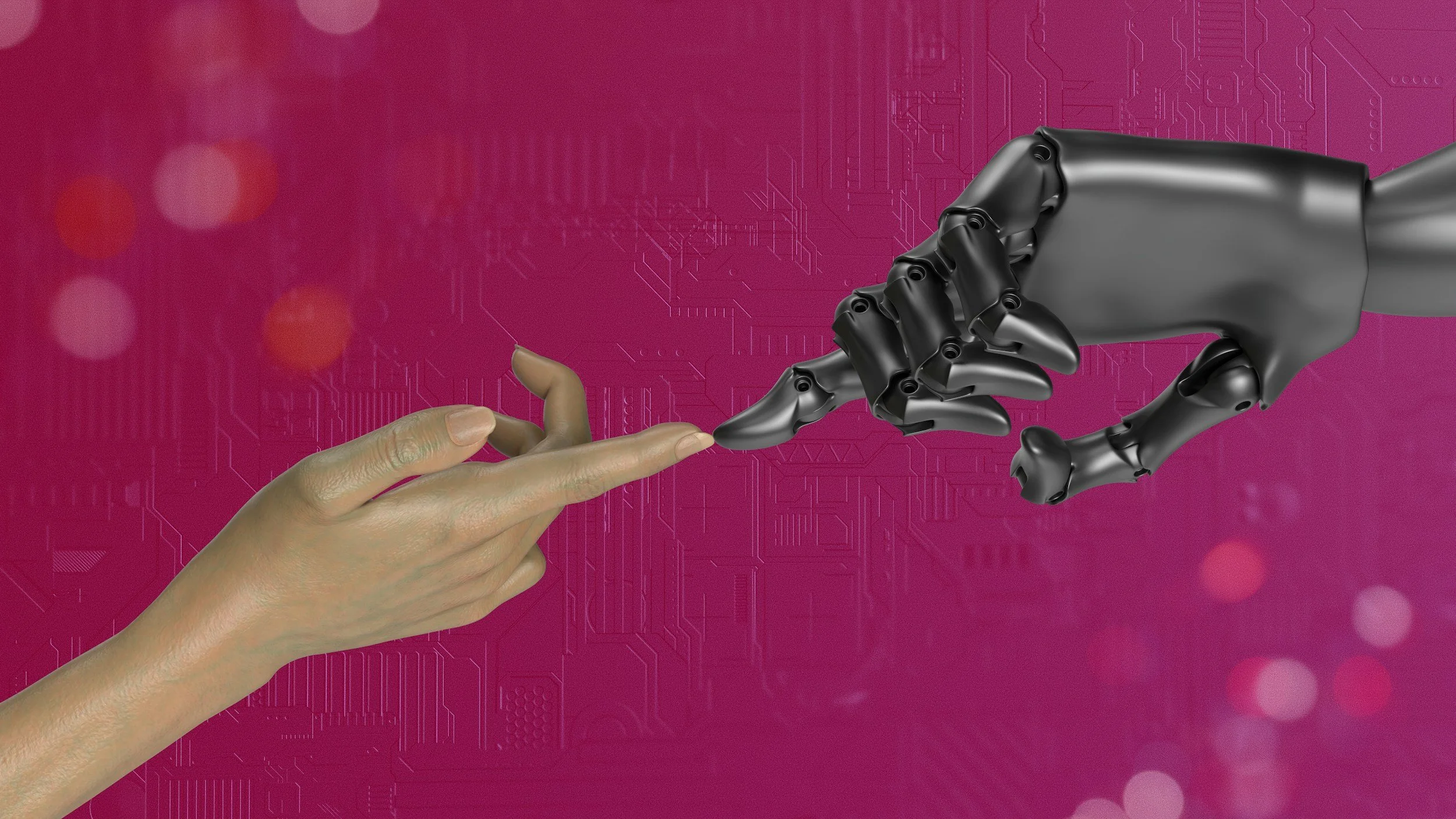
Contact of human and AI
By Dr. Nadia Thalji, PhD
Clinical Psychologist | Intercultural Psychology
We are living in a time of profound acceleration and uncertainty.
Across the world, people are navigating wars, genocide, social unrest, rising xenophobia and racism, economic disparities, political polarization, rapid technological change, increasing workloads, and the intensifying realities of climate change. These forces shape not only our societies but also our inner psychological landscapes.
At the same time, artificial intelligence and digital systems are transforming the way we work, communicate, and increasingly how we understand ourselves.
Amid these global shifts, something subtle yet significant has been happening in our everyday language.
More and more, people describe their minds and bodies using machine terminology.
In therapy sessions, professional environments, and everyday conversations, I increasingly hear expressions like:
“My hardware isn’t functioning well today.”
“My brain just shut down.”
“I need to rewire my brain.”
“I wish I could delete that memory.”
“I need to reprogram myself.”
“My system just crashed.”
“I’m wired this way.”
“I need to reset my system.”
At first glance, these phrases may seem playful or harmless. Yet language shapes perception, and perception shapes how we experience ourselves.
When machine language becomes the dominant way we describe our inner lives, something deeper may be unfolding.
The Rise of Machine Metaphors for the Mind
Throughout history, humans have used the technologies of their time as metaphors to understand the psyche.
During the industrial era, the body was often compared to an engine or mechanical system. Today, in a digital age, the dominant metaphor has become the computer.
This shift appears clearly in everyday language.
Software and Programming Metaphors
Many people now describe their thoughts and behaviors as if they were software that can be rewritten or debugged:
“I need to reprogram myself.”
“That belief is deeply coded in me.”
“I’m trying to debug my thinking.”
“My brain has faulty programming.”
“I need to update my mindset.”
“I’m trying to rewrite my internal script.”
“My brain keeps running the same program.”
These expressions suggest that our inner lives can be modified with the precision of code.
But human experience rarely works that way.
Memory as Data Storage
Another shift appears in how people speak about memory.
Instead of describing memory as a living psychological process, it is increasingly framed as digital storage:
“I wish I could delete that memory.”
“That moment is stored in my brain.”
“I need to clear my mental cache.”
“My brain is overloaded with information.”
“I don’t have the bandwidth to deal with this.”
“I’m trying to archive that part of my life.”
“That experience is still processing.”
These metaphors reveal how deeply digital culture has shaped the way we think about our inner worlds.
Hardware Metaphors for the Body and Brain
Even physical experiences are increasingly described using the language of machines:
“My hardware isn’t working.”
“My brain short-circuited.”
“My system crashed.”
“I need to reset.”
“My brain needs to be rewired.”
While these expressions can serve as convenient shortcuts, they also subtly shape how we imagine ourselves.
Performance and System Language
In fast-paced professional environments, people often speak about themselves like systems that must run efficiently:
“I’m not operating at full capacity.”
“I need to optimize my performance.”
“My system is overheating.”
“I’m running on low battery.”
“I need to recharge.”
“My brain is lagging today.”
This language reflects a broader cultural expectation: that human beings should function like machines that can always be optimized.
The Influence of AI and Algorithmic Thinking
As artificial intelligence becomes increasingly integrated into daily life, new metaphors are emerging:
“My brain keeps looping the same algorithm.”
“I’m trying to train my brain differently.”
“My mind keeps auto-generating worst-case scenarios.”
“My brain is stuck in a feedback loop.”
“I need to retrain my thinking model.”
In subtle ways, the language of AI is beginning to shape how we imagine the psyche itself.
Language, Dehumanization, and the Social Climate
These metaphors do not emerge in isolation.
They appear within a broader global atmosphere marked by war, genocide, social fragmentation, racism, xenophobia, and deepening political polarization.
When societies move toward dehumanization, language often reflects that shift. People begin to be described less as human beings and more as problems to manage, systems to control, or variables within political and economic equations.
In such environments, it becomes easier to lose sight of the human dimension of suffering.
The increasing tendency to speak about ourselves as machines may reflect a deeper cultural drift toward emotional distancing and depersonalization.
Technology itself is not the enemy.
But when efficiency and optimization become the dominant frameworks through which we understand life, we risk losing contact with the very qualities that make us human.
What Depth Psychology Reminds Us
Depth psychology offers a very different way of understanding the human mind.
Rather than viewing the psyche as a machine, depth psychology understands it as something closer to a living landscape.
The psyche contains:
dreams
symbols
imagination
contradictions
unconscious processes
emotional memory
relational experiences
These elements do not operate like code.
They unfold through time, reflection, relationships, and meaning-making.
Healing and transformation rarely happen through “reprogramming.” They occur through understanding, integration, and human connection.
Remaining Human in the Age of AI
Artificial intelligence will continue to reshape the world in extraordinary ways.
Yet as machines become increasingly powerful, an important question emerges:
How do we remain connected to our humanity?
Perhaps one place to begin is with the language we use to describe ourselves.
Instead of seeing ourselves as hardware or software, we might remember that we are:
living bodies
emotional beings
cultural and relational creatures
storytellers and meaning-makers
Our minds are not machines to be optimized.
They are living processes shaped by memory, imagination, relationships, and experience.
And no algorithm can fully capture that.